Let's rewind to the early days of the millennium -- a time when the video landscape was untamed. Back then, YouTube, Netflix, and TikTok were mere figments of the digital imagination. Streaming videos directly from websites were still taking their tentative first steps.
Instead, videos were predominantly consumed as downloaded files. Users would fetch the entire video over their internet connection and then play it using a separate video player application.
To make it even more difficult, there were tons of different video formats in use. Hundreds of different formats vied for attention. Each format required its own codec -- a kind of "driver" for the computer -- to decode and play the specific video format.
Then, in the early days of 2001, a something happened. Experimental video player known as VideoLan Client went through a complete rewrite and was launched as an open source software.
Thus, VLC, in its current incarnation, was born. Its brilliance lay in its ability to handle decoding routines for nearly all conceivable video formats internally. No more fiddling with separate codec installations--the need for that vanished.
The evolution of VLC unfolded gradually after its initial launch. Step by step, VLC added support for new video formats. But it was around the 2010s that VLC truly transformed into a video player capable of handling just about anything.
Google settled a class-action lawsuit in September 2023, which accused the company of distorting the Android app market and abusing its dominant market position in the United States. Today, the company announced the terms of the settlement.
Firstly, it will pay a total of $700 million in compensation to parties and authorities that participated in the class-action lawsuit. Of the amount, which is equivalent to approximately €637 million, 90% will go to consumers who participated in the class-action lawsuit, and the remaining 10% of the compensation amount will go to individual US states.
From the perspective of an average Android user, the bigger significance is that Google intends to simplify the so-called sideloading mechanism for Android as a result of the settlement. This mechanism is used to install applications on Android phones from outside Google's own Play Store.
Currently, the process of downloading apps (typically in .apk file format) with phone's browser and installing it includes several roadblocks that Google has added, to "protect the users". Because of the settlement, the entire process gets streamlined.
Chinese robot vacuum manufacturers have been successful in selling consumers the idea that a robot vacuum combined with a robot mop is a much better solution. However, I personally have been skeptical of this idea for years. There are essentially two reasons for this: first, a lightweight mop cannot actually remove stuck-on dirt from the floor. But more importantly, I have highlighted the fact that a mop completely ruins the idea of easy-to-use robot vacuums.
Well, the world's largest robot vacuum manufacturer, Roomba, has strongly agreed with me on this and has not released any combination device that includes a robot vacuum and mop. However, apparently the pressure from Chinese manufacturers has changed Roomba's mind and they have finally released such a device: Roomba Combo j7+ is Roomba's first robot vacuum with a mop function.
We received the new device for testing in late 2022 and the testing period lasted almost a record-breaking four months because the robot stayed in our test locations for that long. During the testing period, Roomba Combo j7+ was used as the only floor cleaning tool in the test locations, as always during our tests. The robot was used in two very different types of homes during the testing period: one with lots of carpets and obstacles, and another that was very minimalist.
Although robot vacuums have become a commonplace item in households in recent years, their story goes back much further. In fact, robotic vacuums have been around in some form for over 20 years.
For a long time, the market was dominated by a single company, iRobot, and its Roomba product line until a real contender emerged in 2005 with the American company Neato Robotics.
Especially in the 2010s, Neato Robotics gained a loyal following among technology enthusiasts as the company's products brought many innovations to the world of robot vacuums. Neato's robots were the first so-called "connected" robot vacuums, meaning they communicated their actions to the internet - and to a smartphone app. In addition, Neato courted technology enthusiasts by opening up its robots' programming interfaces and enabling the first steps towards a smart home at a time when the term "smart home" was still completely unknown. Furthermore, Neato also introduced LiDARs to the robot vacuum world - at the time when most robot vacuums did their navigation based on guesswork.
Sometime around 2015, Neato was perhaps at its peak and the company's then-current lineup was in many ways the best that the world of robot vacuums had to offer. Unfortunately, the company's development seems to have stalled since those years.
The world's most popular messaging platform, Meta-owned WhatsApp has enabled sending messages to yourself. While at first, this might seem like an odd feature, it can be very useful in a lot of situations.
This means that using WhatsApp as a notepad, adding reminders to yourself, or even sharing links is much easier. Some might find that they don't even require a dedicated notepad app with this addition.
This feature also allows fast and easy access to sharing files between different devices. Messaging yourself can be much easier than sending files to a file-sharing service and downloading them on a different device.
For example with pictures, one can simply send them to their own WhatsApp account and open WhatsApp on another device to access the file.
Here's How to Send a Message to Yourself on WhatsApp
Open WhatsApp (on a mobile device or on the computer)
Click on the new conversation icon on the bottom right.
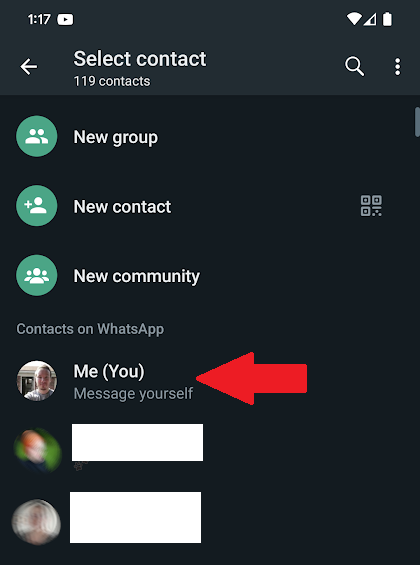
Select your own account from the list of contacts (should be on the top).
Send a message just like you would to anyone else.
A common problem in home networks is a sluggish Wi-Fi connection, which is frustrating to all family members and even when the network is shared with visitors. At its worst, the problems could cause videos to stutter, downloads to stall, and remote work to suffer.
Fortunately, there are a few things one can do to remedy some of the issues that relate to lousy Wi-Fi networks. We've collected some of the best tips on how one can try and fix the problems, regardless of the service provider.
Google shut down its streaming game service Stadia late last month and this means that some people have Stadia controllers lying around that seem to be of no use. That is fortunately not the case, as there's a way to take advantage of the controllers on other platforms.
Google had the controllers restricted to Stadia only when the platform was up and running. However, they support standard Bluetooth connection, which has been enabled by Google for other platforms, now that their platform is defunct.
Enabling the controllers on other platforms requires Google's tool, but the procedure is luckily fairly simple.
The Stadia controller needs to be first connected to a computer via the USB cable.
After that is done, the user needs to direct their Google Chrome web browser on the computer to this Google website. Note that this might not work with other web browsers.
The switching should be enabled in just a few moments by following the instruction on the website.
Google notes that this change is permanent and after switching to Bluetooth mode, the Wi-Fi mode is no longer available.
Sharing a Netflix account with a person in a different location is possible and indeed very common, although the company doesn't necessarily enjoy this behavior from their customers.
However, sometimes sharing of accounts happens even without the knowledge or approval of the account owner. Perhaps the Netflix account was logged in to a TV of an ex-partner, or children have shared the passwords with their friends. Occasionally hacked Netflix accounts are also shared online.
The disadvantages of allowing unwanted guests to use your Netflix account are many. Some of the more important reasons include the following. First is the moral quandary; someone else is using a service I pay for. Another one is that the other user can totally mess up the recommendation algorithm, which is important in finding new content that matches your tastes. And thirdly, this is technically against the User Agreement, which can result in the termination of the service.
Fortunately, Netflix has made it easier for users to kick out unwanted guests. One way to do that was always to switch the password. This would result in changing passwords to all legit devices, and now there's a much faster and more convenient way. Netflix mobile app has a feature, which allows the account holder to check which devices have used the Netflix account recently and from which parts of the world.
Do you know someone whose computer is way beyond its best-before date, and they, unfortunately, do know have the skills or the expertise to do much about it? Or do you own a pile of old laptop computers that do not have any use as is?
Google offers a simple and straightforward solution for these situations: ChromeOS Flex. The new ChromeOS version released in the summer of 2022 turns any old Windows, Linux, or Mac computer into a Chromebook. And what's better, it's all free.
Chromebooks and the operating system run on them, ChromeOS, are meant to be a lightweight solution that removes most of the unnecessary clutter that comes with a regular computer. Moreover, much of the computing happens in the cloud, which makes having powerful, heavy, high-consumption components unnecessary. This means that even a lesser computer can run ChromeOS efficiently.
The only thing you'll need in addition to the computer the operating system is going to be installed on is an empty thumb drive. As you test out the OS, everything is run from the thumb drive, so no files will be lost at first.
Google promises the compatibility of ChromeOS Flex only on officially supported devices, but our experiences are that ChromeOS Flex seems to work on practically all somewhat old Windows computers. However, Apple's computers, using the new proprietary Apple chip, do not work with ChromeOS Flex.
Robot vacuums are meant to make day-to-day life easier in several ways. When they are used efficiently, they can keep the house clean continuously - at least when it comes to floors. In addition, by using the timed cleaning features, the noise made by the vacuums isn't a worry.
However, the problem is that there is a wide array of different kinds of robot vacuums at various price points and from a myriad of manufacturers. There are both cheap and expensive models not worth investing in like there are good products at all price points. Even affordable vacuums can be perfectly fine, although with more money comes more features.
We have tested robot vacuum at AfterDawn since 2018. Our product-specific test periods usually last for several months, so we gain actual real-world results and find out quirks and problems that one might not find in short reviews. This also gives us a great overview on how a wide range of robot vacuums compare.
What do you need to know when choosing a robot vacuum?
Here we are going to list the most important points and features that one should consider before purchasing a robot vacuum.
Year 2022 was supposed to be the year when we were planning to get out of the pandemic and get back to normal lives. Well, Russia decided differently and the entire year will be remembered as the year when a new war started in Europe.
Despite the war and horrors of it, tech world had some interesting developments during the year - lets try to wrap those changes up here.
The rise of the artificial intelligence
Since the very dawn of computing history, people have dreamed about the possibilities of artificial intelligence. Turing test has existed for decades and every now and then we've heard about the developments in AI research.
But the yeat 2022 as the year when AI finally became part of our everyday lives.
It all started with DALL-E in Spring of 2022, when OpenAI released its text-to-images AI project to the public. Suddenly, the entire web was flooded with psychedelic images created by the weird artificial intelligence software.
Soon after, in summer of 2022, open source world pushed the envelope further, by releasing Stable Diffusion project. An open source project doing exactly the same as DALL-E did: generate images from text prompts, but doing that better and with more customization options.
Chinese phone manufacturer OPPO has grown in recent years in Europe and Asia and has become one of the major Android phone manufacturers in the world. Now, company is following the footsteps of other Android manufacturers and is improving its update policy dramatically.
From year 2023 onwards, all new OPPO flagship models will be eligible for 4 major Android operating system updates and 5 years of security patches. Basically all new OPPO flagship phones released next year with Android 13 will get updated to Android 14, Android 15, Android 16 and finally to Android 17.
New policy matches the policy in place for Samsung and is in line with OPPO's sister brand, OnePlus, which made recently a similar policy change for its upcoming flagship models.
Policy change wont cover those phones released in year 2022 or before that, so current flagship models like OPPO Find X5 Pro wont be eligible for the four updates.
OPPO hasn't made any official statement on how midrange phones or low-end phones will get updates in future. But it is obvious that the longetivity of the phones is getting more and more important for consumers - and manufacturers are responding to that need.
Samsung sent us their modern, top-level robot vacuum cleaner for our test and review.
The Samsung Jet Bot 90 AI+ has a whopping price tag of around €1,400, and is the Korean CE giant's first attempt to push itself to the top of the world of robot vacuum cleaners.
We tested the robovac, which first went on sale in 2021, for a month and a half. As always, in our test we examine not only the cleaning power of the vacuum cleaner, but also its ease of use and especially the practicality of the device in a Finnish home.
The first half of the test period was spent in a typical and "easy" Finnish home, from the point of view of a robovac. The other half was a more challenging environment, including the presence of a pet that sheds hair, a bunch of carpets of varying thickness and shape, and a significant number of different obstacles that can make life difficult for a robot vacuum cleaner.
Due to our extensive past experience testing robot vacuum cleaners, we have a good understand of the potential challenges and problem areas that a robovac can encounter while doing its duty.
We received the Garmin Forerunner 955 smartwatch for review a few months ago, just after it was released in the summer of 2022. Depending on the variant, the smartwatch costs around $500 and is among the more expensive options from Garmin's selection of smartwatches.
The Forerunner model in particular is designed for specifically runners and exercise, as one can imagine from its product name. It is a direct successor to Garmin's Forerunner 945, which we tried previously and liked.
We took the new Forerunner for an extensive test during the three-month testing period, using it around the clock. We used the watch to measure exercise, sleep, stress, and general well-being.
After a long and arduous testing period, it is time to see what Garmin Forerunner 955 is about and how it handled our tests.


 Let's rewind to the early days of the millennium -- a time when the video landscape was untamed. Back then, YouTube, Netflix, and TikTok were mere figments of the digital imagination. Streaming videos directly from websites were still taking their tentative first steps.
 Google settled a class-action lawsuit in September 2023, which accused the company of distorting the Android app market and abusing its dominant market position in the United States. Today, the company announced the terms of the settlement.
 Chinese robot vacuum manufacturers have been successful in selling consumers the idea that a robot vacuum combined with a robot mop is a much better solution. However, I personally have been skeptical of this idea for years. There are essentially two reasons for this: first, a lightweight mop cannot actually remove stuck-on dirt from the floor. But more importantly, I have highlighted the fact that a mop completely ruins the idea of easy-to-use robot vacuums.