
AfterDawn: Tech news

Google reveals which countries have the most sites with malware

Written by Andre Yoskowitz @ 25 Jun 2013 9:11 User comments (5)

Google reveals which countries have the most sites with malware

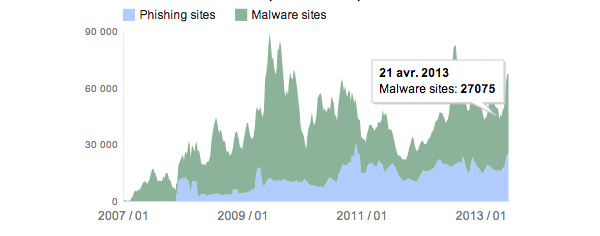
Google has updated their Transparency Report to include a new section in which they highlight malware.
Says the site: "Google Safe Browsing scans millions of websites to identify those sites that install malware without a user's knowledge. We discover and categorize these sites by autonomous system (AS) numbers, thousands of which exist on the Internet."

Additionally, there is a heat map that allows you to mouse over every country and view the rate of sites infected with malware or attempting to phish personal information.

The U.S. scored very well, with a malware rate of 2 percent. Latin American countries like Mexico and Chile had higher rates, 12 and 11 percent respectively, while India, Bosnia, Hungary and others had massive 15 percent rates.

Google does note that the data is "not comprehensive and is best viewed as an indicator of the global malware problem." Check the heat map here: Google TR


(Pic via Om)

Previous Next  

5 user comments

126.6.2013 02:53

Wow, Australia is 7%.

22.7.2013 21:57

Well that is easier than you would think. You need to spend plenty of assets to keep it low. One of my web hosts is completely ignorant about bot net threats but they were brought down today. I bet they will get smarted real fast! As of today I am more educated then their chief tech. I reamed him out a few days back. I am locked out of my own sites because of hackers.

34.7.2013 00:16

Originally posted by Mez:
Well that is easier than you would think. You need to spend plenty of assets to keep it low. One of my web hosts is completely ignorant about bot net threats but they were brought down today. I bet they will get smarted real fast! As of today I am more educated then their chief tech. I reamed him out a few days back. I am locked out of my own sites because of hackers.
How frustrating for you.

46.7.2013 14:54

The hosting companies are their own worst enemies. A large portion of the web designers are artists with barely sufficient tech skills to get the job done. If the had more skill they could do something else and make twice the money. All my problems started by giving one of them a very limited password for one on my sites. Her computer was infested with bot nets which took over that one site but then brute force cracked the master password for the rest of my sites. They could guess the ID from the database name. That is the latest wrinkle with bot nets you can brute force crack passwords if you can guess the ID then have several million zombies make one try per site per day.

Knowing that, the hosts need to be VERY up on what hackers are doing and scan the sites daily shutting down any site with malware on it. Give the owners clear instructions as to what to do. That web designer that screwed me over was clueless as to what was going on. She knew her computer wasn't infected even though I even told her the bot net that infected her. I downloaded the website ran a virus scan then looked for the injection frames with an editor. I have several hosts and only the one that I gave her a password to has had problems.

56.7.2013 23:31

That's bad luck Mez. Botnet designers/users are parasites in my book and aught to be first to be lined up against the wall.

We go to every effort ourselves... all our final financial transactions are done on Puppy Linux on Seamonkey browser. Don't know what we would do actually hosting any sites. Just used the brilliant ComboFix from bleepingcomputer.com yet again freeing yet another customer's poot from blackmailing him.

Comments have been disabled for this article.

Latest news

Sony suspends memory card sales because memory chips are simply not available Sony suspends memory card sales because memory chips are simply not available (28 Mar 2026 6:49)
Sony has announced that it is temporarily suspending the sale of memory cards used in mobile phones and digital cameras, among other things. The company states that the reason is problems with the availability of memory chips.
Austria plans to ban social media for under 14 year olds Austria plans to ban social media for under 14 year olds (28 Mar 2026 6:17)
Austria is planning to ban social media for children under 14. The reform aims to protect children from harmful effects and addictions, but at the same time, it is problematic from a privacy perspective.
TP-Link urges users to update their routers - several vulnerabilities patched TP-Link urges users to update their routers - several vulnerabilities patched (26 Mar 2026 1:56)
Serious security vulnerabilities have been discovered in several TP-Link router models, for which patches were released at the end of March 2026. The company urges users to update their router software immediately.
Google: The feared Q-Day is now expected to happen in 2029 Google: The feared Q-Day is now expected to happen in 2029 (25 Mar 2026 4:32)
Google has advanced its estimate of when current forms of encryption will become insecure. The moment is called Q-Day, or Quantum Day, when the computational power of quantum computers will be sufficient to break currently used encryptions.
OpenAI shuts down its AI video service Sora OpenAI shuts down its AI video service Sora (24 Mar 2026 6:28)
OpenAI has decided to shut down Sora, its AI video creator, just months after its release. The decision is due to issues such as copyright problems and the deepfake phenomenon.

News archive