
AfterDawn: Tech news

Google Translate for Android adds offline support for 50 languages

Written by Andre Yoskowitz @ 28 Mar 2013 10:07 User comments (3)

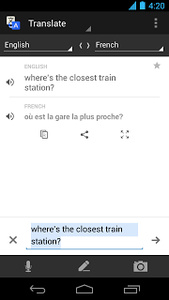
Google Translate for Android adds offline support for 50 languages Google has announced today that it has added offline language support to its Google Translate app for Android.
The search giant says the new support is good for fifty languages ranging "from French and Spanish to Chinese and Arabic."

As a caveat, the company says the offline offerings are "less comprehensive" than if you were connected to the Internet but it should do fine if you need the occasional word.

To be able to use the service offline, you will need to download language packs from within the installed app.

The Google Translate app is free in the Google Play store.

Previous Next  

3 user comments

128.3.2013 10:18

Its like the universal translator in Star Trek :D

228.3.2013 10:36

Originally posted by xyqo:
Its like the universal translator in Star Trek :D
... or the Babel fish from The Hitchhiker's Guide To The Galaxy. Most tablet computers even look like "The Guide" itself.

328.3.2013 17:11

Or the telepathic field produced by the translation circuit in the Tardis Data Core.

Actually i think i remember Amit Singhal saying in october of last year it was the Star Trek communicator that was the inspiration for it in some article some place.

Comments have been disabled for this article.

Latest news

GitHub Copilot to train its AI with users' prompts, code - here's how to opt out GitHub Copilot to train its AI with users' prompts, code - here's how to opt out (30 Mar 2026 3:49)
GitHub, the world's largest code repository for software development projects, owned by Microsoft, will start using user interactions to train its AI models.
Sony suspends memory card sales because memory chips are simply not available Sony suspends memory card sales because memory chips are simply not available (28 Mar 2026 6:49)
Sony has announced that it is temporarily suspending the sale of memory cards used in mobile phones and digital cameras, among other things. The company states that the reason is problems with the availability of memory chips.
Austria plans to ban social media for under 14 year olds Austria plans to ban social media for under 14 year olds (28 Mar 2026 6:17)
Austria is planning to ban social media for children under 14. The reform aims to protect children from harmful effects and addictions, but at the same time, it is problematic from a privacy perspective.
TP-Link urges users to update their routers - several vulnerabilities patched TP-Link urges users to update their routers - several vulnerabilities patched (26 Mar 2026 1:56)
Serious security vulnerabilities have been discovered in several TP-Link router models, for which patches were released at the end of March 2026. The company urges users to update their router software immediately.
Google: The feared Q-Day is now expected to happen in 2029 Google: The feared Q-Day is now expected to happen in 2029 (25 Mar 2026 4:32)
Google has advanced its estimate of when current forms of encryption will become insecure. The moment is called Q-Day, or Quantum Day, when the computational power of quantum computers will be sufficient to break currently used encryptions.

News archive