
AfterDawn: Tech news

News written by Petteri Pyyny (August, 2003)

AfterDawn: News

RIAA vs subpoena fighter "Jane Doe" continues

Written by Petteri Pyyny @ 29 Aug 2003 12:34

RIAA vs subpoena fighter "Jane Doe" continues The only case so far where an alleged file swapper has decided to fight against a subpoena requested by the RIAA is heating up. The Californian woman, known by the court only as "Jane Doe" and by the RIAA by her Kazaa username Nycfashiongirl, has stated through her attorneys that she is innocent to the alleged copyright infringements.

Now, the fact remains that whether she is guilty or not, doesn't have any relevance whatsoever to the subpoena clause in DMCA law that allows copyright owners to find out alleged copyright violator's personal details. Earlier this year Verizon, American ISP, lost its case where it tried to protect the personal information of one of its subscribers and was forced to hand out the subscriber details to RIAA.

So, according to the DMCA, if copyright holder has any proof whatsoever that the user might be responsible of copyright infringements, the ISP of that user has to hand out the personal details to the copyright holder. Copyright holder is not required to sue the user after they've got the personal details.

Read more...


AfterDawn: News

Group of webcasters sue RIAA

Written by Petteri Pyyny @ 28 Aug 2003 3:46

Group of webcasters sue RIAA The webcasting a.k.a. Net radio issue is back in headlines again. Group of small net radio operators, the Webcaster Alliance, has sued RIAA over the webcasting royalty issue.

The whole mess, that has taken years to solve, was created by the U.S. Congress in 1998 by setting up a royalty fee for Net radio broadcasts (while traditional radio stations in the U.S. don't pay any royalties whatsoever). The mistake they made was that they didn't specify how much the royalty fee should be.

Anyway, the last decision that was made about the royalty rates was made after talks between RIAA and small group of webcasters, most notably including all the biggest webcasters, that set the current royalty rates. Current system is that webcasters pay royalties based on certain percent of their revenue (with an exception of large webcasters who pay fixed price per each broadcasted minute).

Now the Webcaster Alliance has sued RIAA because it claims that RIAA has refused to negotiate with them for alternative royalty rates and claims that the group of webcasters that negotiated the current royalty system didn't represent webcasters in general, but only a group of specific type of webcasters.

Read more...


AfterDawn: News

BBC plans to open up its video vaults

Written by Petteri Pyyny @ 27 Aug 2003 3:21

Big Mommah of all government owned non-commercial broadcasting companies, UK's BBC, is planning to bring parts of its massive video selection available through Internet for free.

The corporation won't bring its massive entertainment collection to Net however, because its DVD sales figures are just too lucrative to justify such a move, but it has plans to bring other shows, documentaries, etc available to the public. The schedule and pretty much all the technical details are still unknown.

More information: Independent


AfterDawn: News

European campaign against software patents

Written by Petteri Pyyny @ 26 Aug 2003 3:08

European campaign against software patents Scientists and concerned web users all over the European Union have started rallying against the proposed software patent directive that is going to be submitted for European Parliament on 1st of September.
Traditionally, most European countries don't allow patenting software at all, but there has been a huge variety of differences between EU member states as some of the countries have similiar software patent laws to those of the U.S. Now the new software patent directive is trying to enforce all member nations to approve software patents, pretty much in identical way to American software patent system.

Many European scientists and software developers -- both commercial and specially open source developers -- have raised their voices against the proposed legislation and now the grassroot movement against the legislation is getting ready for real life protest in Brussels tomorrow.

Some of the prime examples of valid software patents in the U.S. include blinking cursor and nested menus.. Do we want similiar patents that would curb software development and make lawsuits such as the one that SCO has filed against the Linux community possible in Europe? If you don't want this to happen, please consider signing this petition and visit this page as well for questions on how to oppose the directive.


AfterDawn: News

DeCSS lost its "free speech" protection

Written by Petteri Pyyny @ 25 Aug 2003 4:50

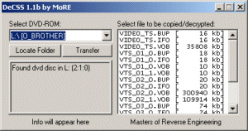
DeCSS lost its "free speech" protection Californian Supreme Court decided today that a piece of code that we know as the DeCSS code, can't be protected by U.S. constitution's free speech amendment.

The case was filed originally back in 1999 by DVD CCA against dozens of Californian (and, apparently, residents from other states as well) residents, accusing them of violating DVD CCA's trade secrets by distributing a code, the DeCSS, that allows circumventing the copy protection mechanisms found on DVD-Video discs.

District court originally granted a preliminary injunction against the individuals that banned them from distributing the code. Other defendants on the case accepted the decision, but one individual, Andrew Bunner, took the case to appeals court. Appeals court stated in November 2001 that distributing the DeCSS code is protected by the First Amendment (the free speech amendment in American constitution), but DVD CCA took the case to the California Supreme Court which now delivered its decision.

Read more...


AfterDawn: News

Movie industry blames IM and SMS for movie flops

Written by Petteri Pyyny @ 22 Aug 2003 5:26

This summer's major movie flops, such as The Hulk and Gigli didn't fail because of their bad script, bad acting or just overall lack of originality. Not at least if you listen to movie studios.

Movie studios claim that the habit of spreading the bad words about movies to your friends after you've seen a movie that you considered as a "not worth paying for" is to blame. And specifically the new technologies, such as instant messaging and mobile phone text messages (SMS) are to blame.

According to movie studios, five years ago the so-called drop-off rate between movie's premiere weekend and the second weekend was appx. 40 per cent in the UK and now it is 51 per cent.

Now, we're waiting anxiously when MPAA decides to ban mobile phones and IM tools -- obviously they are to blame, 10 years ago people didn't have any means to communicate with each others and even Really Bad Movies made profit, right?

Source: The Independent


AfterDawn: News

Californian woman challenges RIAA's subpoena

Written by Petteri Pyyny @ 21 Aug 2003 3:59

Californian woman has filed a case against the music industry lobby group RIAA in order to get a subpoena that was filed against her, to be overturned.

According to her -- she has filed the case anonymously and is only referred as "Jane Doe" in court papers -- lawyers, RIAA's methods of seeking individuals' personal information from ISPs by using the DMCA law's subpoena clauses, violate her privacy and her constitutional rights.

"This [seeking personal info of file swappers] is more invasive than someone having secret access to the library books you check out or the videos you rent," said Glenn Peterson, one of the attorneys, in a statement.

She is the first individual to challenge RIAA's rights to obtain personal data after Verizon lost its subscriber privacy case in New York against RIAA.

Source: News.com


AfterDawn: News

Labels and studios will appeal the P2P ruling

Written by Petteri Pyyny @ 20 Aug 2003 3:30

Major record labels and movie studios announced yesterday that they will appeal the court ruling that was delivered back in April that gave a first major court victory for P2P networks.

In the ruling, federal court decided that P2P companies Grokster and Streamcast Networks (owner of the P2P tool Morpheus) weren't liable for the copyright infringements that happen in their P2P networks.

"...decision was wrong," RIAA President Cary Sherman said in a statement Tuesday. "These are businesses that were built for the exclusive reason of illegally exchanging copyrighted works, and they make money hand over fist from it. The Court of Appeals should hold them accountable."

"Grokster and Streamcast are not significantly different from companies that sell home video recorders or copy machines, both of which can be and are used to infringe copyrights," Judge Wilson wrote in his decision back in April.

RIAA says that Wilson ignored earlier court decision that involved the legendary Napster in which case Napster was held liable for copyright infringements its users made using its network. But according to Grokster's spokesman the judge followed that case very closely and managed to see the structural differences between Napster and Grokster/Morpheus (that were both based, at the time of the case was filed, on FastTrack network which doesn't use central servers unlike Napster did).

Read more...


News archive