
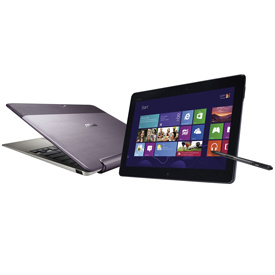
 Asus has unveiled their first Windows 8 tablets, the Vivo Tab and Vivo Tab RT.
In development, the two devices were knows as Asus Tablet 600 and Tablet 810, so the new names are certainly a step up.
The Vivo Tab has an 11.6-inch IPS+ display with 1366x768 resolution. The display offers a 10-point multitouch and has a Wacom digitizer and an included stylus makes drawing and taking notes easier. The tab is 0.34-inches thick and weighs 1.48 pounds. Inside is an Intel Atom, 2GB RAM and 64GB internal storage.
Furthermore, the tablet has dual cameras, 8MP/2MP with autofocus and LED flash and NFC. Like most Asus mobile products, there is a docking keyboard with full size chiclet keyboard and trackpad, with two USB ports. A second battery should extend battery life by 5 hours.
The Vivo Tab RT runs on Windows RT, has a Tegra 3 quad-core processor, 2GB RAM, a 12-core GPU, 32GB storage, dual cameras, NFC, GPS, G-sensor, Light sensor, gyroscope, and compass. The screen is 10.1-inches with 1366 x 768 resolution IPS+ display.
Price is still unknown, but chances are they will be on the expensive side given the specs.
The Vivo Tab has an 11.6-inch IPS+ display with 1366x768 resolution. The display offers a 10-point multitouch and has a Wacom digitizer and an included stylus makes drawing and taking notes easier. The tab is 0.34-inches thick and weighs 1.48 pounds. Inside is an Intel Atom, 2GB RAM and 64GB internal storage.
Furthermore, the tablet has dual cameras, 8MP/2MP with autofocus and LED flash and NFC. Like most Asus mobile products, there is a docking keyboard with full size chiclet keyboard and trackpad, with two USB ports. A second battery should extend battery life by 5 hours.
The Vivo Tab RT runs on Windows RT, has a Tegra 3 quad-core processor, 2GB RAM, a 12-core GPU, 32GB storage, dual cameras, NFC, GPS, G-sensor, Light sensor, gyroscope, and compass. The screen is 10.1-inches with 1366 x 768 resolution IPS+ display.
Price is still unknown, but chances are they will be on the expensive side given the specs.