
Six years ago in June Steve Jobs revealed the first Retina display in the form of iPhone 4. It wasn't necessarily anything mind boggling, although the concept they used was new.
According to Apple back then, 330 PPI display of the iPhone 4 was enough to outperform your retina from a standard viewing distance. In the coming years Apple's Retina displays and others have improved upon the pixel density and on some Android phones we're looking at nearly 600 PPI.
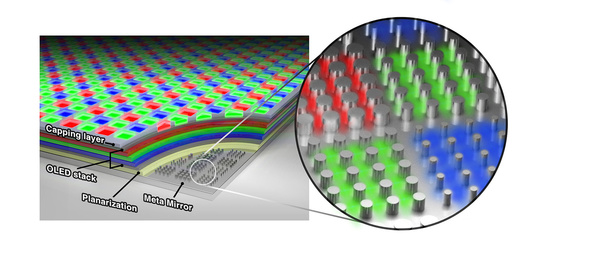
However, these are minor changes in technology compared to what Samsung and Stanford University researchers have been working on. Stanford has released a paper about an OLED display that could reach 10,000 PPI.
This would mean that the width of one pixel is 0.001 inches, or around 2540 nanometers, and you could create a Full HD resolution screen that measured just around 0.2 inches wide.
As mentioned, the display is based on OLED technology that Samsung is a pioneer in, but some of the insights came actually from science of nanoscale photonics the researchers were using developing in new type of solar panels.
Obviously creating a smartphone display, much less a PC screen or TV, with this sort of pixel density is currently not convenient. You would need much more processing power to run it at full resolution, but in smaller screens that need to be denser, like in VR, it could be revolutionary.
So, while it might not immediately translate into 50K displays on your Galaxy phones, it could be very important in all sorts of applications.
However, these are minor changes in technology compared to what Samsung and Stanford University researchers have been working on. Stanford has released a paper about an OLED display that could reach 10,000 PPI.
This would mean that the width of one pixel is 0.001 inches, or around 2540 nanometers, and you could create a Full HD resolution screen that measured just around 0.2 inches wide.
As mentioned, the display is based on OLED technology that Samsung is a pioneer in, but some of the insights came actually from science of nanoscale photonics the researchers were using developing in new type of solar panels.
Obviously creating a smartphone display, much less a PC screen or TV, with this sort of pixel density is currently not convenient. You would need much more processing power to run it at full resolution, but in smaller screens that need to be denser, like in VR, it could be revolutionary.
So, while it might not immediately translate into 50K displays on your Galaxy phones, it could be very important in all sorts of applications.