
AfterDawn: Tech news

News written by Jari Ketola (January, 2003)

AfterDawn: News

Verizon to appeal court ruling

Written by Jari Ketola @ 31 Jan 2003 3:47

Verizon to appeal court ruling Internet access provider Verizon Communications has asked the appeals court to block a previous court ruling that forces Verizon to disclose the identity of a P2P user to RIAA.

"Verizon will use every legal means to protect its subscribers' privacy," said John Thorne, a senior vice president for Verizon. "If this ruling stands, consumers will be caught in a digital dragnet, not only from record companies alleging infringement of their copyright monopolies, but from anyone who can fill out a simple form."

Verizon does not oppose disclosing the identity of the customer, but the legal methods used by RIAA to request it. RIAA is trying to use fast legal procedures provided by the DMCA to get the name of the pirate. Verizon sees that it violates the privacy of their customers and insists that RIAA must file a lawsuit before getting anything.

If RIAA has its way, they could obtain the identities of thousands of users at a whim.

Source:
News.com



AfterDawn: News

Internet café found quilty for piracy

Written by Jari Ketola @ 29 Jan 2003 8:51

Internet café found quilty for piracy easyInternetcafé chain has been found quilty of copyright infringement by British High Court. The chain allowed users to access music download sources on the Internet, and burn the downloaded files on CD for a fee of £5 (about $8).

The British Phonographic Industry (BPI), Sony Music, EMI, and Universal Music Entertainment started fighting the service already 18 months ago. EasyInternetcafé withdrew the service, but BPI still demanded compensation thought to be up to one million pounds ($1.5M). The court, however, did not set any penalties yet.

EasyInternetcafé is a part of the easyGroup, founded by Stelios Haji-Ioannou. He is also behind companies like easyCar, easyJet, and Stelman Tankers. Haji-Ioannou will appeal against the judgement.

Source:
vunet.com


AfterDawn: News

Student fined in Norway for online piracy

Written by Jari Ketola @ 24 Jan 2003 6:26

Frank Bruvik, a Norwegian student from the city of Lillehammer, was found quilty of online piracy on Wednesday. Bruvik had developed a Web service that allowed visitors to download copyrighted music files simply by clicking links on his page Napster.no.

"This was the most high-profile piracy site in Norway for downloading music and an important victory for us," Saemund Fiskvik, director general of the International Federation of the Phonographic Industry in Norway, told Reuters.

Bruvik was sued by IFPI, the Nordic Copyright Bureau, Norway's TONO performing rights society, and record labels, such as EMI, BMG, and Sony Music.

The fine ordered by the court was 100,000 Norwegian crowns (about $14,520). The original claim was five times larger than that.

"The ruling said it is illegal to distribute the links, but that it's legal to use them. That is a victory for all Internet users in Norway," said Bruvik's lawyer Stray Vyrje.

Bruvik will probably appeal the ruling.

Source:
Reuters


AfterDawn: News

Sand Video to provide a H.264 chip

Written by Jari Ketola @ 13 Jan 2003 3:06

Sand Video to provide a H.264 chip Sand Video Inc. demonstrated a high-definition (1,920 x 1,080i), real-time H.264 decoder implemented on two Xilinx Inc. field-programmable gate arrays at the Consumer Electronics Show last week. The company promised to deliver commercial samples of a silicon implementation in Q4 of 2003.
H.264 is one of the competing encoding standards for the upcoming HD-DVD standard. DVD-Forum decided to go with the old red-laser technology with HD-DVD, which means that in order to provide high-definition picture, new codec has to be used in place of the current MPEG2. Red-laser technology severely limits the capacity of the storage medium and hence MPEG2 is out of question at higher resolutions.

Sand Video will be delivering both an H.264 encoder, and an H.264 encoder/decoder chip. The chips also decode MPEG2 video for full backwards compatibility. The company will also be providing a "companion chip", which will work with an existing MPEG-2 decoder IC. With the companion chip DVD-player manufacturers can easily add support for HD-DVD, should DVD-Forum go with H.264 for HD-DVD9.

Read (much) more on the topic at EE Times


AfterDawn: News

Norwegian court: Johansen not quilty

Written by Jari Ketola @ 07 Jan 2003 8:27

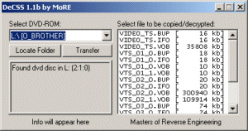
Norwegian court: Johansen not quilty Jon Lech Johansen, now 19, was found not quilty on Tuesday by the Norwegian court. Johansen was accused of violating computer break-in laws by contributing to the development of DeCSS, a tool that circumvents DVD copy protection.

"I'm very satisfied. We won support on all points. I had figured that we could win, but it can go either way," said Johansen after the verdict was read.

The three-member court was unanimous in its decision. Hollywood representatives will most likely appeal, because of the nature of the case. The ruling will set a model for courts around the world in future similar cases.

Source:
Wired


AfterDawn: News

US Supreme Court: Hollywood can't sue Pavlovich

Written by Jari Ketola @ 04 Jan 2003 7:14

US Supreme Court: Hollywood can't sue Pavlovich The U.S. Supreme Court reversed an earlier temporary hold on a case involving DVD descrambling on Friday. The stay was initially requested by DVD CCA to prevent DeCSS sourcecode from being posted on the Web again. The U.S. Supreme Court upheld a California Supreme Court decision ruling that the entertainment industry cannot force a Texas resident who published a software program on the Internet to stand trial in California.

The California Supreme Court decided on November 25, 2002, that Matthew Pavlovich, who republished an open source DVD-descrambling software program called DeCSS, will not have to defend a trade secret lawsuit simply because he knew that his publication could cause "general effects" on the motion picture and technology industries in California. The court laid out clear jurisdiction rules for claims arising from publishing information on the Internet.

"The entertainment companies should stop pretending that DeCSS is a secret," said EFF Legal Director Cindy Cohn. "The Supreme Court wisely recognized that there is no need for an emergency stay to prevent Mr. Pavlovich from publishing DeCSS."

The Pavlovich decision is one piece of a larger legal struggle over Internet publication of DeCSS by thousands of individuals in fall 1999. European open source developers created DeCSS so they could play their DVDs on Linux computers among other uses. DVD CCA, the sole licensing entity for a DVD-scrambling technology called CSS, sued hundreds of named and unnamed individuals and entities in the case on December 27, 1999.

Read more...


News archive