AfterDawn: Tech news

Latest news

AfterDawn: News

Gartner: IT spending to increase minimally this year due to currency fluctuation
Written by Andre Yoskowitz @ 07 Jul 2013 2:22

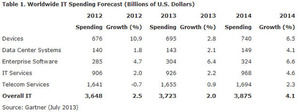
Gartner: IT spending to increase minimally this year due to currency fluctuation According to research firm Gartner, global IT spending will hit $3.7 trillion this year, up just 2 percent from last year's $3.6 trillion.

The prediction is down from last quarter's forecast of 4.1 percent, mainly thanks to recent wild fluctuations in th exchange rates for the U.S. dollar.

Spending on IT devices (hardware) is expected to grow a measly 2.8 percent, down from the firm's forecast of 7.9 percent. The drop in notebook and desktop PC sales that exceeded double figures last quarter is not expected to relent, and new devices nor the release of Windows 8.1 is expected to help, says Gartner.

Tablet growth, while robust at a forecasted 38.9 percent this year, will not be able to make up the difference. Mobile phone growth will also remain strong at 9.3 percent.

"Exchange rate movements, and a reduction in our 2013 forecast for devices, account for the bulk of the downward revision of the 2013 growth," Gartner managing vice president Richard Gordon said in a statement. "Regionally, 2013 constant-currency spending growth in most regions has been lowered. However, Western Europe's constant-currency growth has been inched up slightly as strategic IT initiatives in the region will continue despite a poor economic outlook."



AfterDawn: News

Microsoft kills off 90s set-top technology MSN TV

Written by Andre Yoskowitz @ 07 Jul 2013 2:02

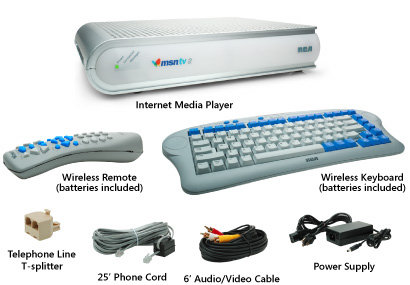
Microsoft kills off 90s set-top technology MSN TV In 1997, Microsoft purchased a technology called WebTV, long before the boom of smart TV features and set-top boxes that we see now in even basic hardware.

For their $425 million, Microsoft never made a success of the tech, and they have now decided to cease operations as of September of this year.

One analyst, at the time, said WebTV "may be the product that could turn the World Wide Web into a mass-entertainment medium." It did not, and companies like Google and Apple have been trying to do the same in the last few years.

The WebTV kit consisted of the set-top, a keyboard and a remote and allowed users to surf the Web and check emails, but not too much else.

It was eventually broken up and converted into MSN TV, with most of the team sent over to work on Microsoft's MediaRoom or Xbox Live services.


AfterDawn: News

Vancouver startup offering cheap gigabit Internet

Written by Andre Yoskowitz @ 07 Jul 2013 12:23

Vancouver startup offering cheap gigabit Internet OneGigabit, a new Vancouver-based startup, will offer fiber Internet speeds of one gigabit, equal to Google's pilot speeds in the U.S., and over 60 times faster than the average Canadian household.

More importantly, the company will charge only $45 to $65 per month, with no bandwidth caps.

It was recently reported that the average monthly Canadian Internet bill is $54 and the average downstream speed is 16.6 Mbit/s. A gigabit connection will have speeds of up to 1000 Mbit/s.

Fiber connections remain limited in Canada, as only certain neighborhoods have availability. The big three Canadian ISPs, known to be complete ripoffs no matter what they offer, sell fiber packages with download speeds of up to 250 Mbit/s for $115-$200 per month.

OneGigabit and its founder Eric Kunkhe plan to negotiate with real estate owners and developers in an effort to expand fiber connections to more citizens.


AfterDawn: News

Android 4.2 update for HTC One removes oft-criticized menu bar, adds many features

Written by Andre Yoskowitz @ 07 Jul 2013 11:57

Android 4.2 update for HTC One removes oft-criticized menu bar, adds many features AndroidCentral has reported on the new Android 4.2 update for the HTC One.

The update just began hitting devices this week across the globe, with the full rollout expected to take three weeks.

HTC appears to have addressed many of the complaints for the device and its HTC Sense overlay, while adding a few new features, as well.

The company has added the Daydream screensaver, quick settings toggles, lock screen widgets, separated the power saver option, made screenshots instantly sharable, added new templates to the Highlights video app, and integrated the popular Instagram into their own BlinkFeed. You can also swipe up from the home screen to access Google Now, just like in stock Android.

Finally, the company has killed off the black menu bar that would show up in certain applications.

Read more...


AfterDawn: News

Amazon, Barnes & Noble drop prices on tablets for European consumers

Written by Andre Yoskowitz @ 07 Jul 2013 11:15

Amazon, Barnes & Noble drop prices on tablets for European consumers Amazon and Barnes & Noble have announced price drops on their respective tablets this weekend, in an effort to boost sales in Europe.

Barnes & Noble, which recently announced it would stop manufacturing tablets and instead license its Nook platform, has dropped the price to clear out any remaining inventory.

In the UK, the only country to have Nook tablets, the prices have been dropped to £99 for the 8 GB model 7-inch Nook HD (down from £129) and the 9-inch Nook HD+ has fallen to £149 from £179.

Amazon has also discounted their Kindle Fires across the board. The 7-inch Kindle Fire HD will now start at £139 (down from £159) in the UK and start at €169, down from €199 for the rest of Europe.


AfterDawn: News

BBC shuts down future plans for 3D

Written by Andre Yoskowitz @ 07 Jul 2013 10:40

BBC shuts down future plans for 3D The BBC has announced it will be ending all 3D plans, at least until 2016.

The popular broadcaster has been trialing films and some sporting events in 3D for the last year, but has now decided the investment is not viable. A Doctor Who 50th anniversary special in November will be the last of the 3D broadcasts.

It is becoming increasingly clear that companies that tried to jump on the 3D bandwagon over the last two years have been severely disappointed by the results.

Just last month, ESPN announced it would be shutting down its 3D broadcasts by the end of the year, citing lack of adoption.

Kim Shillinglaw, the BBC's head of 3D, had easily the best explanation for why the general public doesn't care about 3D, saying it is "quite hassly" to get it to work. It should have been confirmed years ago, but it is now clear that nobody wants to put on glasses to watch TV and get a headache.


AfterDawn: News

Intel-powered 'Milky Way 2' is now world's fastest computer

Written by Andre Yoskowitz @ 06 Jul 2013 7:44

Intel-powered 'Milky Way 2' is now world's fastest computer China has returned to the number one spot for world's top supercomputer for the first time since 2010.

As part of the biannually updated Top500 Supercomputer list, China's National University of Defense Technology's Tianhe-2 (a.k.a. "Milky Way 2") came out on top, with performance of 33.86 petaflop/s on the Linpack benchmark.

33.86 petaflops was over twice the performance of the top-rated computer of the last list.

The Milky Way 2 supercomputer runs on 48,000 Intel Xeon Phi coprocessors and 32,000 Xeon processors. Combined, the computer has 3,120,000 computing cores.

2012's champion, the Titan, was a Cray XK7 system with 17.59 petaflop/s performance.

The Titan is currently housed at the U.S. Department of Energy's Oak Ridge National Laboratory.


AfterDawn: News

Rovio teases new adventure game 'Tiny Thief'

Written by Andre Yoskowitz @ 06 Jul 2013 7:27

Rovio teases new adventure game 'Tiny Thief' Rovio has teased their upcoming iOS game, Tiny Thief, a "point-and-tap stealth adventure game taking place in a medieval fantasy world."

Set for release on July 11th, the game will first launch on the iPhone and iPad and within a few weeks for Android.

In the game, you play the role of the world's tiniest thief.


AfterDawn: News

Nintendo kills off Wii vitality sensor

Written by Andre Yoskowitz @ 06 Jul 2013 7:06

Nintendo kills off Wii vitality sensor Nintendo president Satoru Iwata has confirmed that the company has killed the Wii vitality sensor before it was ever released.

The device in question was shown off at E3 in 2011 and never released. The fingertip sensor was supposed to check your pulse and "a number of other signals" but it appears it did not work on everyone. Only for 90 percent of people tested did the device work.

"The Wii Vitality Sensor is an interesting device, and we did various experiments to see what is possible when it was combined with a video game. But, as a result, we have not been able to launch it as a commercial product because we could not get it to work as we expected and it was of narrower application than we had originally thought," noted Iwata.

Iwata also added that if the technology can be improved to work for everyone, it may become commercially viable.


AfterDawn: News

FCC approves SoftBank acquisition of Sprint and Sprint purchase of Clearwire

Written by Andre Yoskowitz @ 06 Jul 2013 6:31

FCC approves SoftBank acquisition of Sprint and Sprint purchase of Clearwire The FCC has formally approved Japanese carrier SoftBank's acquisition of Sprint, and approved Sprint's purchase of the rest of Clearwire and its 4G spectrum.

In their statement, the FCC says the deal would serve the public interest and "accelerate the deployment of mobile broadband services and enhance competition."

Softbank, Japan's third largest carrier, will pay $21.6 billion for a controlling 78 percent stake in Sprint, the U.S.' third-largest carrier.

As part of its approval, SoftBank has agreed to not use Chinese networking equipment in the U.S.

"We would like to thank Acting Chairwoman Clyburn, Commissioners Rosenworcel and Pai, as well as the staff of the FCC for their thorough review of these transactions," said Sprint CEO Dan Hesse. "Just two years ago, the wireless industry was at the doorstep of duopoly, but with these transformative transactions, we are one step closer to a stronger Sprint which will better serve consumers, challenge the market share leaders and drive innovation in the American economy."


AfterDawn: News

Did Google pay Adblock Plus to not block their ads?

Written by Andre Yoskowitz @ 06 Jul 2013 5:44

Did Google pay Adblock Plus to not block their ads? According to multiple reports, Google has been paying the makers of Adblock Plus to not block their ads.

Adblock Plus is the most popular extension for both Chrome and Firefox, due to its ability to block banners, display ads and pop-ups during browsing.

The report claims that Google (and others) have been paying to be included on a "whitelist" that prevents blocking by the free browser extension.

Adblock Plus normally offers whitelisting for free to smaller websites under its Acceptable Ads whitelist, which states "unobtrusive ads should remain viewable as long as they aren't annoying."

In their FAQ, the company says "Managing this list requires significant effort on our side and this task cannot be completely taken over by volunteers. That's why we are being paid by some larger properties that serve nonintrusive advertisements."


AfterDawn: News

Site shows off upcoming plastic iPhone

Written by Andre Yoskowitz @ 06 Jul 2013 5:08

Site shows off upcoming plastic iPhone Over the past few months, there have been many rumors about a lower-cost plastic iPhone, one that will sell at a lower price point than the current flagship and may come in multiple colors, like the iPod Touch.

Today, tech site Techdy has posted pictures and video of what they believe are legitimate front and back pieces for the alleged phone.

Supposedly, the front panel will be black, but the rear shell will be available in white, green, blue, pink and yellow.

Check the video for a full look at the supposed device, which is expected to be released in September.

Read more...


AfterDawn: News

Source: Google will not reveal Moto X phone at upcoming event

Written by Andre Yoskowitz @ 06 Jul 2013 4:18

Source: Google will not reveal Moto X phone at upcoming event Earlier this week, Google sent out invites to a special media event on July 10th and 11th.

In the poster, one of the people is jumping off a dock into the water with his hands and legs forming an "X," adding to speculation that the company would unveil the oft-hyped Moto X flagship.

This week, popular tech world podcaster Leo Laporte said he received a personal invite from Motorola's Guy Kawasaki, and speculated it would also be the X: "He said we'd really like you to come down to the Google campus for an event -- small group of journalists, 50 people, two groups; July 10th and July 11th... I'm thinking it's the phone."

A Cnet source claims, however, that a Moto X reveal is not in the cards for the event.

We will see next week.


AfterDawn: News

Samsung to spend $4.5 billion on new R&D centers

Written by Andre Yoskowitz @ 05 Jul 2013 10:41

Samsung to spend $4.5 billion on new R&D centers The world's largest phone maker, Samsung, will be spending a huge sum to upgrade their R&D capabilities.

Samsung will be building five new R&D centers around Korea over the next three years, spending $4.5 billion to do so.

One research center, to open in Seoul in late 2015, will house 10,000 employees all focusing on design.

Besides design, the centers will also specialize on material and component development, as well as chips and display.

Samsung is known to invest top-dollar in R&D, spending $10.5 billion in 2012, alone.


AfterDawn: News

MasterCard no longer blocking donations to WikiLeaks

Written by Andre Yoskowitz @ 05 Jul 2013 8:58

MasterCard no longer blocking donations to WikiLeaks After almost three years of blocking all donations to WikiLeaks via their processing channels, MasterCard has reversed course following a lawsuit that was filed in Iceland.

Since 2010, VISA, MasterCard, PayPal, Bank of America and Western Union have all blocked processing on donations to WikiLeaks after the group released thousands of classified US diplomatic cables.

Reads WikiLeak's press release:

WikiLeaks was notified of MasterCard International's change in position by VALITOR, the Icelandic partner for VISA and MasterCard.

On April 24, 2013 WikiLeaks and DataCell won a lawsuit, which had been running for two years, against VALITOR for breach of contract and blockading WikiLeaks' donations at the behest of VISA and MasterCard. The Icelandic Supreme Court ordered VALITOR to recommence processing donations to WikiLeaks.

VALITOR complied and reopened its payment gateway, but gave formal legal notice that it would terminate its contract and reclose the gateway on July 1, 2013, citing a unilateral termination clause in the contract.

Read more...


  Newer entries Older entries  

News archive